Trade Winds new

As many people know, when pianist Rachel Iwaasa and I activate our Wonder-Twin powers we magically transform into our flute-piano duo, Tiresias. Back in the summer of 2008, Rachel and I, still basking in the glow of our first album, Delicate Fires, decided it was time to start work on a new CD.

All I can say is: wow, time flies.

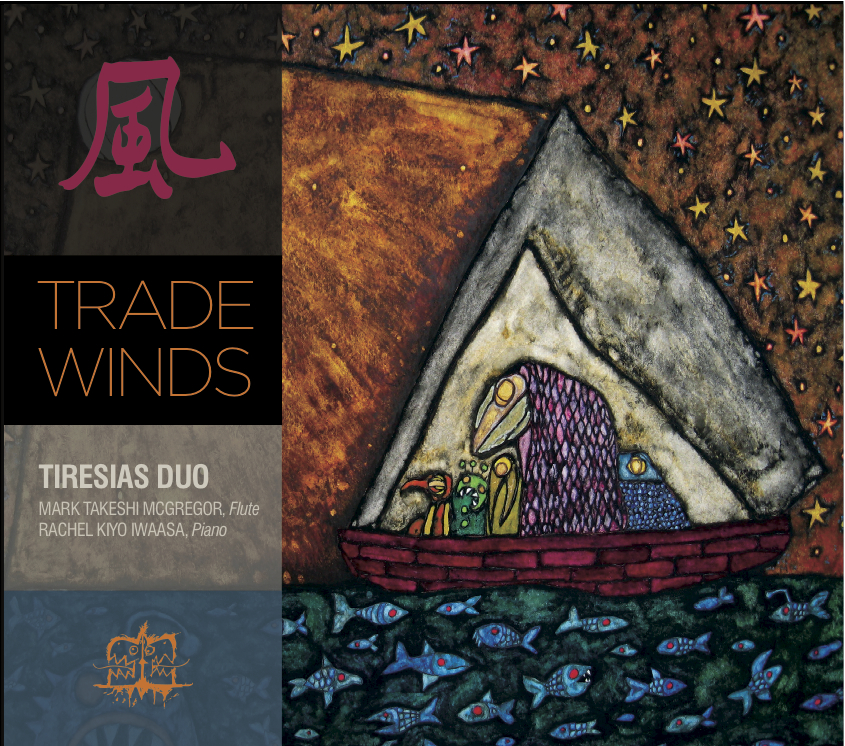
Today — almost five years later — the CD stork (disguised cunningly in a brown UPS outfit) dropped off a box full of sleek little packages containing our new recording, Trade Winds. One of the nice things about taking five years to make a CD is that you have time to record a lot of music — in fact, Trade Winds is so freaking huge we had to make it a double album! That’s right, there are two discs: one recorded in 2008 at the UBC Recital Hall in Vancouver, the other in 2012 at the Banff Centre for the Arts. Disc One explores the musical ties between Canada and Japan — a theme that Rachel and I have great affection for, given that we’re both Hapa (a mixture of Japanese and Western heritage). This cultural exchange is explored from a number of angles: Japanese composers with ties to Canada, Canadian composers of Japanese lineage, and Canadian composers of Western heritage who had been influenced by some aspect of Japanese culture. Works on this disc include staples of the 20th century flute/piano repertoire by Toru Takemitsu and Jo Kondo, as well as new and recent works by Canadian composers Kara Gibbs, Elliot Weisgarber, Anthony Genge, Hiroki Tsurumoto, and Derek Charke. Disc Two showcases the music of three generations of West Coast Canadian composers: Jean Coulthard, Paul M. Douglas, and Christopher Kovarik. These works continue in the vein of Brahms, Mahler, and Debussy, reveling in lush harmonic tapestries and unabashed lyricism. Both programmes are incredibly diverse, ranging from the dissonant savagery of Derek Charke’s Distant Voices to the virtuosic post-Romanticism of Christopher Kovarik’s Sonata for Flute and Piano to the Asian-inflected melodies of Elliot Weisgarber and Paul M. Douglas. And all of it encased in a beautiful package designed by Simon Butler at Thinksavvy Designs (Simon, you continue to rock my world). None of this could have happened without the incredible skill and patience of our recording technicians, Emma Laín, Zana Corbett, and David Simpson, as well as the generous financial support of the Canada Council for the Arts, the UBC School of Music, and the National Association of Japanese Canadians. Trade Winds is released on Redshift Records. I’ll be posting again soon about our CD launch concert, but in the meantime here are some images from the CD jacket and booklet design (photos by SD Holman and Jack McKeown), as well as some Soundcloud snippets of select tracks — enjoy!

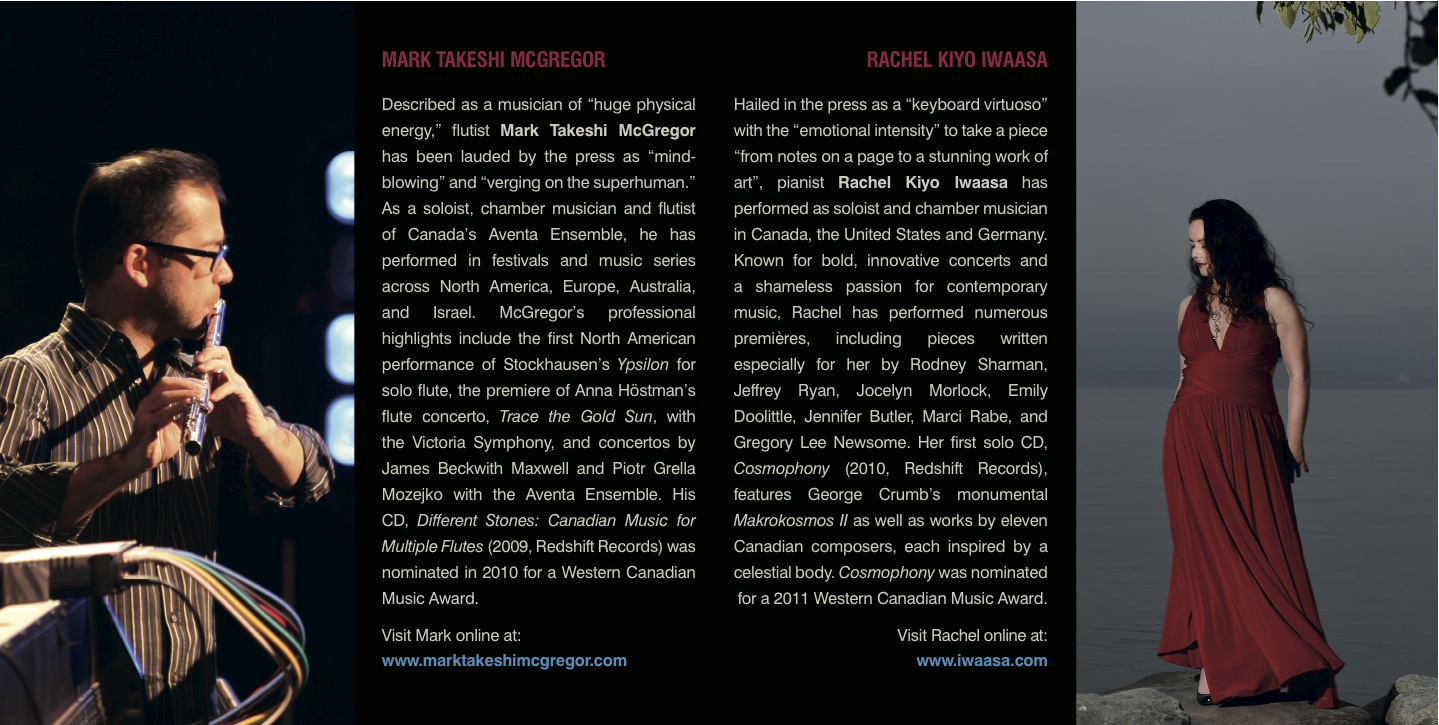
Trade Winds example 2

Trade Winds example 1

“Energetically” from Untitled Scenes: Two Remembered and One Imagined by Kara Gibbs:

“Misty Evening at Saga” from Miyako Sketches by Elliot Weisgarber:

Morlock-McGregor

On March 26th the folks at Music on Main will be fêting the Canadian composer Jocelyn Morlock with a concert dedicated exclusively to her music. This is a singular opportunity to hear a hand-picked selection of some of her very best vocal and chamber music — including the premiere of a brand new piece for violin and piano entitled Vulpine. For this event I’ll be presenting two works of hers: I conversed with you in a dream for flute and piano with Rachel Kiyo Iwaasa, and Vespertine for flute and harp with Joy Yeh. Moreover, you’ll be able to hear what I consider to be some of her most beautiful writing for voice: Involuntary Love Songs, featuring the soprano Robyn Driedger-Klassen and pianist Rachel Iwaasa. This concert is part of a series of events naughtily known as “One Night Stands”: evening-long musical exposés of a particular contemporary composer. To call this a special event is a profound understatement: Morlock’s music is positively fecund with gorgeous melodies, dark humour, and dreamy mysticism. (And yes, I really wanted to use the word “fecund”.)

Jocelyn’s work is well-documented on the internet. She maintains a website and a blog which is updated regularly, so learning more about her and her music is not a difficult thing to do. So instead of repeating details that are easily found elsewhere, I’ve decided to let you in on some of the darker machinations of this composer. You see, I’m not just Morlock’s colleague — I’m her roommate. We’ve shared an apartment (with Smokey, my geriatric pet newt) for some five years now in Vancouver. So, in the spirit of exposé, here are three oddities surrounding this Canadian composer that may (or may not — probably not, now that I think about it) help you appreciate her music:

1. The Kitchen Rule. In our apartment, gossip and secrets tend to be divulged in the kitchen. I’m not sure why, but I suspect it has something to do with the proximity of both coffee and beer. That said, if one of us proclaims that what’s about to be said is “in the kitchen”, the listener is bound to secrecy and cannot judge the speaker in any way. Furthermore, one can “invoke the kitchen” without actually being in the kitchen — the most common non-kitchen location being the living room (because we’re simply too lazy to get up and walk five feet), though other “makeshift kitchens” have included public transit, the izakaya bar down the street, and a hotel room in Kelowna.

2. She might be a vampire. Morlock is convinced that she composes better at night. Unfortunately for her, there are all those pesky daylight hours getting in her way. So what does she do? Why, she convinces her body that it’s nighttime. All the time. When a commission deadline looms, she draws the blinds, lights candles in her room, and shuts out the world. On those rare occasions when she emerges from her studio, one finds her donning a housecoat and slippers — all this at 1:30pm in the afternoon. If you find me in a housecoat at midday it usually means I’m slacking off; encountering Jocelyn in a housecoat is like stumbling upon a head-bobbing iguana: stay out of the way, deadline is imminent!

3. She knits. To call Morlock an avid knitter is like saying it occasionally rains in Vancouver. If she isn’t composing, she’s knitting things that are both practical and beautiful. See, for example, the lovely red scarf she knitted me — it’s actually helping me play the marimba. Alright, I admit that’s a total lie: I was really just looking for an excuse to post this photo of me pretending to play a marimba (but seriously, she did knit me the scarf).

396974_10150611597727952_1605260340_n

This photo doesn’t really do the scarf justice: they’re only a slightly visible here, but the scarf is covered (covered!) with round, wooly teats. Yes, that’s right: teats. When adorned properly, the scarf can make one’s torso resemble the underside of a she-wolf — striking to say the least, and a wonderful ice-breaker in almost any social situation. I ask you: when was the last time your roommate made you a scarf with teats? Hmm??

Music on Main presents

One Night Stand: Jocelyn Morlock with the Music on Main All-Star Band

Tuesday, March 26, 2013

Cellar Restaurant & Jazz Club

3611 West Broadway

Door opens at 6:30 pm, Music starts around 8:00 pm

Tickets: $25

Ensemble 1534
Ensemble 1534 performing Le Marteau sans maître by Boulez at the National Arts Centre, Ottawa, on 12 January 2013.

I’ve never been a devout believer in astrology, but I have to admit: I’m the archetypal Sagittarius. The “typical traits” of the Sagittarius will vary from source to source, but there are a handful of characteristics that seem universally agreed upon. For example, we tend to exaggerate everything (I mean it! Absolutely everything!). We’re also known to be short-tempered (guilty), tactless (yup), and garrulous (my students know that I have six moderately amusing anecdotes that I recycle mercilessly). But there’s also this: Sagittarians love to travel. So when presented with the opportunity to tour and perform with ensembles like Aventa and Ensemble 1534, I practically pee myself with excitement (please see earlier comment regarding tendency to exaggerate).

Aventa’s 2013 Tour will kick off in Montreal, where we’ll be performing as part of the SMCQ’s festival, Montréal Nouvelles Musiques, on February 27th. The very next day we’ll be heading down to Brooklyn, NY where the band is being presented by Roulette. From there we’ll head to Winnipeg (my first time in Manitoba!) to perform as part of GroundSwell‘s series on March 2nd, followed by New Works Calgary on March 4th, and finally back to Aventa’s home base in Victoria on March 5th. The tour repertoire includes new and recent works by Michel Gonneville, Jocelyn Morlock, Laurie Radford, Kaija Saariaho, and Simon Steen-Andersen. If you live in or near any of these cities, come out and hear this truly audacious and beautiful programme.

Immediately after Aventa’s Victoria finale, it’s off to Toronto for Ensemble 1534’s second concert of the season. Named for the year of Jacques Cartier’s first voyage to the New World, Ensemble 1534 is comprised of musicians throughout Canada who have dedicated themselves to the performance of contemporary music. The programme includes two virtuosic ensemble works by the French composer Philippe Leroux: AAA and VOI(rex), as well as recent pieces by Laurie Radford and Giorgio Magnanensi. But I also have the honour of giving the Ontario premiere of a work for solo flute entitled Avarice by the Toronto-based composer Gregory Lee Newsome. A couple years back I asked seven composers to each write a solo flute piece based on one of the Seven Deadly Sins — Greg chose “Greed” and the resulting piece, Avarice, deftly portrays the sin’s ability to corrupt and destroy by gradually disintegrating the sound of the flute. Avarice was commissioned with assistance from the Ontario Arts Council, so it’s a nice feeling being able to “bring it home”. Ensemble 1534 will be performing this programme twice: the first on March 9th at the National Arts Centre in Ottawa, the second on March 10th at the Music Gallery in Toronto.

The Call for Scores went out yesterday for a new trio I’m performing with: McGregor-Nesselroad-Barnes Trio, featuring Brian Nesselroad on percussion, Ariel Barnes on cello, and yours truly on flutes. Brian, Ari, and I have all worked together on various occasions, but this will be our first attempt as a trio. The folks at Vancouver Pro Musica will be presenting our inaugural concert in May of 2013, which will consist entirely of new, submitted works by BC composers. If you are one of those BC-based composers, and the idea of writing for us tickles your fancy, you can download all the necessary information here. The deadline for submissions is February 4th, 2013. Selected pieces will be workshopped on February 17th, allowing time for any revisions before our May performance. Any further questions, feel free to give me a holler directly: marktmcgregor@yahoo.ca. Happy Holidays!

Mark Takeshi McGregor, flute; Brian Nesselroad, percussion.
Ariel Barnes, cello.


People say that CDs are going the way of the dinosaur, but a new CD can still engage me in a way that downloaded music does not. Beyond the sheer joy of listening to good music performed well, I’ve always been a big fan of thoughtful, beautiful packaging. A CD isn’t just a means of presenting music; it can also be an opportunity to showcase great artwork, excellent design, and liner notes that can both enlighten and entertain the listener.

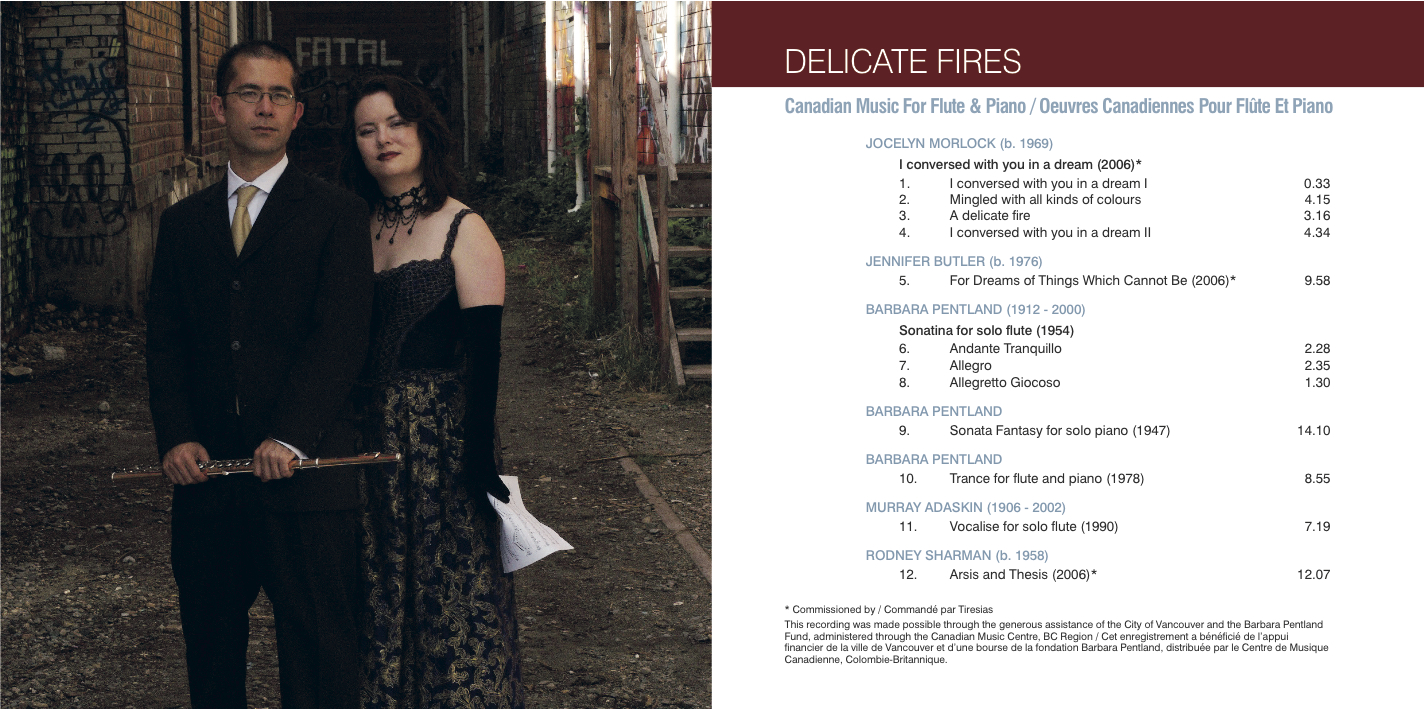
Nearly six years ago Tiresias Duo (my flute-piano duo with Rachel Kiyo Iwaasa) released Delicate Fires: Canadian Music for Flute and Pianothanks to a grant from the Canadian Music Centre BC Region. This CD was a “first” in a number of ways: for both Rachel and me, it was our first commercially available CD recording; the disc also featured three beautiful, newly commissioned pieces by BC composers Jennifer Butler, Jocelyn Morlock, and Rodney Sharman — all of which have enjoyed multiple performances over the years; finally, Delicate Fires was the first CD to be released on the Redshift Records label (the catalogue is is now up to six CDs, with another three on the way). I still remember sitting at the kitchen table with (my then) Co-Artistic Director Jordan Nobles, both of us giggling like a couple of pathetic nerds when we decided to give Delicate Fires the catalogue number “TK421” (hardcore Star Wars fans will appreciate the reference).

Some time last year we realized that we would soon deplete our stock of Delicate Fires CDs, but thanks to generous funding from the City of Vancouver, we were able to afford a second run that not only would keep this CD available for years to come, but would also allow for a sleek new graphic makeover by Simon Butler at ThinkSavvy Designs and bilingual programme notes by Caroline Gauthier. The reissue also features some shots from a photo session Rachel and I did a few years back with the incredibly talented S.D. Holman. And the CD still features cover art by my good friend, the gifted Vancouver-based painter Nancy Blanchard.
And the most exciting part? The CDs arrived on my doorstep today. I’ve included some highlights from the booklet below.

We all have moments that define our lives. For me, one of those moments is hearing Arnold Schoenberg’s Pierrot Lunaire for the first time. I was seventeen when I first heard it performed by the Little Chamber Music Series That Could, conducted by the late and great Wallace Leung. I know statements like “it changed my life forever” are overused…. but seriously, it changed my life forever. I was haunted by it for months after. I couldn’t believe something so psychologically twisted could be so luminously beautiful. I was even reassured by it — all that internal psychobabble that we’re so afraid to admit to in public, it was all there. I often say Pierrot is one of my favourite pieces of music from the 20th century, but that’s not entirely fair: it’s one of my favourite pieces ever.

I’ve been fortunate to have played this piece on numerous occasions: in Victoria, in Prince George, in Montreal, in Vancouver for my DMA degree, and even once in Switzerland alongside an all-star cast that included Stephen Isserlis, Dmitry Sitkovetsky, Sharon Kam, Kent Nagano, and the Icelandic pop sensation Björk (an event that remains one of the more bizarre experiences of my life). But these next couple of days are truly special: I’m honoured to perform Pierrot Lunaire with an amazing roster of musicians: Robyn Klassen (soprano), Cris Inguanti (clarinet), David Gillham (violin), Marcus Takizawa (viola), Ariel Barnes (cello), Corey Hamm (piano), and Marguerite Witvoet (conductor). The energy in this group is unbelievable: this is a Pierrot that is vital, throbbing, passionate, and so, so incredibly dark and twisted.

For anyone who isn’t familiar with the world of Pierrot: Pierrot Lunaire Op. 21 was written by Arnold Schoenberg in 1912 for singer/actress and chamber ensemble. The poetry is by Albert Giraud (translated into German by Otto Erich Hartleben). Schoenberg selected twenty-one of these poems and set them to music; they remain some of the eeriest, cleverest, most beautiful stuff ever written. This half-hour song cycle describes the antics of Pierrot, a sadistic clown from the Commedia dell’ arte, drunk on moonlight, carrying out the most outrageous antics: at one point he grabs his friend Cassander and plays him as though he were a giant viola; another time he is convinced that he will be decapitated by the sickle-shaped moon; elsewhere he captures the hapless Cassander, drills a hole in his head(!), stuffs it full of Turkish tobacco and smokes him like a pipe. Seriously, you can’t make this stuff up — well, unless you’re Giraud.

In order to pull Pierrot off, you need an exceptional singer. And I’m so thrilled that we’re working with the incredible Robyn Klassen (yes, she’s better than Björk. Like, way better). Robyn perfectly captures the demented side of Pierrot while still imbuing him with heartbreaking humanity. In fact, it’s a little unsettling how easily she slips into the Pierrot psyche. Just sayin’…

Pierrot Lunaire is presented by those monsters at Music on Main, who continue to provide Vancouver with some of the most innovative programming ever. Come join us at the Western Front either Monday the 15th or Tuesday the 16th, grab a drink at the bar, and hear one of the greatest, darkest, most beautiful masterpieces of the 20th century.

Pierrot Lunaire

Monday, October 15 & Tuesday October 16th, 2012

9:00pm

Western Front 303 E 8th Ave, Vancouver

Bar opens at 8:00 pm, Concert starts at 9:00 pm

Single Tickets: $35 ($15 for students)

Victoria, BC is my home-away-from-home. Without question, I spend more time there than any other city besides Vancouver. There are a number of reasons for this: 1.) the beer is spectacular. Really, I mean it: it boasts some of the best microbreweries in North America, including Phillips, Driftwood, and Spinnakers; 2.) the local gin is outstanding. Victoria Spirits is owned and operated by the Murray family, who not only created the most beautiful sipping gin ever, but continues to be stalwart supporters of the arts; 3.) there is an amazing musical culture that is entirely unique — the musicians and composers there continue to be an incredible source of  inspiration and cultural nourishment for me, and my association with the Aventa Ensemble remains one of the most exciting musical collaborations I’ve ever had the privilege of experiencing.

So when Victoria’s Open Space asked me to present a concert there this Friday, October 12th, I took the offer very, very seriously. In addition to works for solo flute by Kajia Saariaho, Toru Takemitsu, Salvatore Sciarrino, and Toronto-based composer Gregory Lee Newsome, I’ll be presenting three recent works for flute and percussion with my longtime friend and collaborator Brian Nesselroad: Coming Home by Farshid SamandariIyr by Dubravko Pajalic, and a new premiere for alto flute and percussion, For Annette Brosin, by Victoria-based composer Darren Miller.

If you’re in Victoria this weekend, please consider coming to this concert: the music is incredible, and Brian and I have had a blast putting this repertoire together. And for the record, I want a t-shirt made from the poster image below — I was informed that those are actually flutes burning merrily away…

Mark McGregor, flute and Brian Nesselroad, percussion

Open Space 510 Fort Street, Victoria BC

October 12, 2012 at 8:00 p.m.

General $15; Members, Students $10

I have a confession: I become a monstrous slob when my schedule gets busy. And given that this September has been one of the craziest months ever for me, I think it’s safe to say I’ve degenerated into the world’s worst roommate. As I type this I am snugly nestled between precariously piled towers of dishes, music scores, CDs, instruments, and the occasional beer bottle. But I’m happy to say that it’s all for good reason: this week is the Modulus Festival, and I’m so thrilled to be a part of it. Brought to you by the ingenious folks at Music on Main, the Modulus Festival runs from Sept. 27 – 30 at Heritage Hall, Main Street, Vancouver.

This year’s programme is particularly dear to me: on Thursday the 27th I’ll be teaming up with violinist Müge Büyükçelen to give the world premieres of two works by the internationally acclaimed British composer Michael Finnissy. The first, entitled Mercy and Mankind, is inspired by a Medieval morality play in which Mercy instructs Mankind to resist the temptations of the flesh, warning of the “battle betwix the soul and the body” (Mankind quickly fails in his endeavours to remain virtuous and eventually falls in with the less-than-reputable Three Vices). Mercy and Mankind is at times playful, at times darkly ominous — and the sudden changes from one character to another can be both amusing and disconcerting. Finnissy’s second work for us, Sesto Libro di Gesualdo, is a two-movement character sketch of the great Italian Renaissance composer, Carlo Gesualdo. Gesualdo remains one of the more outrageous figures in the world of classical music: returning home early from a hunting trip, he discovered his wife in bed with another man. Consumed by jealous rage, Gesualdo brutally murdered his wife, her lover, and some accounts say he even murdered his infant son, doubting the child’s paternity. To make matters worse, the corpses were publicly displayed on the steps of his palace. Being of nobility, Gesualdo could not be prosecuted for crimes of passion, but the murders would nevertheless haunt him for the rest of his life. Finnissy’s new work presents two chilling portraits of the man: one quietly plagued with doubt, obsession, and guilt; the other engulfed in blinding rage.

September 30th’s concert celebrates the music of another of my favourite composers, Kaija Saariaho. Featuring soprano Robyn Klassen, violinist David Gillham, cellist Becky Wenham, pianists Rachel Iwaasa and Corey Hamm, percussionist Brian Nesselroad, harpist Albertina Chan, and myself, this programme deftly balances warhorses and rarities by this incredibly innovative composer. Personal highlights include Oi Kuu for bass flute and cello (a piece that is at once both incredibly strange and attractive) and Terrestre for solo flute and chamber ensemble — a stunning showpiece that has the flutist not only playing, but shouting, screaming, and reciting text. If you know Saariaho’s music, you know that this isn’t a show to be missed; if you aren’t familiar with her music yet, you’re in for a treat: this music is complex, delicately nuanced, intensely coloured, and utterly delicious.

Summer can be a time of feast or famine for the freelance musician: typically this is when most concert seasons are winding down, but it’s also when a lot of interesting festivals start revving up. I had the privilege of being a part of two truly unique musical celebrations this month: the National Flute Association‘s 2012 conference in Las Vegas and the 2012 Queer Arts Festival in Vancouver.

The American-based National Flute Association is, hands down, the largest flute organization in the world, with approximately 6,000 members from over 50 countries. The annual convention is held each August in a different American city, where literally thousands of flutists from across the world converge to listen, learn, share, and network. This year’s convention took place in Las Vegas — at no less prestigious a venue than Caesar’s Palace! On Friday, August 10th, fellow flutist Jessica Raposo and I presented a concert at the convention entitled “True, North, Strong, and Free: New Works by Canadian Composers”. Jessica gave a beautiful performance of “Sleeves of Green” by Yvonne Gillespie, while I gave the American premiere of Christopher Kovarik‘s Sonata for Flute and Piano with virtuoso pianist Kenneth Broadway; Kovarik himself was in attendance for the event. Our performance concluded with Jessica, Ken, and me performing Butterflies for two flutes and piano by the Okanagan composer Imant Raminsh. The concert was fun, well attended, and enthusiastically received — despite the 8:30am start time! (Seriously, this is absolutely the earliest I’ve ever had to perform — and I am not a morning person.) This was my first flute convention ever, and I’m greatly indebted to Jessica for bringing it to my attention, and for allowing me to share this prestigious opportunity with her. Looking forward to the 2013 convention… in New Orleans!

With flutist Jessica Raposo and pianist Kenneth Broadway, following our performance at the 2012 NFA Convention in Las Vegas.

The NFA convention wasn’t even half-over before I was on an early morning flight back to Vancouver to perform at the Queer Arts Festival. My flute-piano duo Tiresias (with the indefatigable Rachel Kiyo Iwaasa) presented what was arguably our most ambitious project to date, Boulez Contra Cage: an Interdisciplinary Argument for Two Musicians and Two Actors. Adapted from the published correspondence of Pierre Boulez and John Cage, Boulez contra Cage dramatizes the friendship, conflict and schism of two of the most influential composers of the 20th century. Sounds dry, you say? Guess again. Actors David Bloom (as Boulez) and Simon Webb (as Cage) brought this dialogue to life, presenting both composers as ingenious, eccentric, occasionally exasperating, and at times utterly hilarious. Interspersed throughout their repartee Rachel and I performed the music of both composers, including Cage’s Two for flute and piano, and selections from Boulez’s titanic Sonatine for flute and piano. The concert concluded with the premiere performance of Musique d’art pour flûte et piano by the Montreal composer Simon Martin. Martin’s piece was commissioned especially for this event as a way of bringing together the compositional methods of both Boulez and Cage — and demonstrating that the differences that divided the two men were not, in the end, so incompatible. If you live in Vancouver and missed this unique performance, fear not! We’ll be repeating it at the Western Front on November 24th, 2012.

Before the show: Rachel Iwaasa preparing the piano for Cage’s Sonata V (from Sonatas and Interludes).
Actor Simon Webb (as Cage) and Rachel Iwaasa performing Cage’s Water Music (1952).
The Ice Man cometh! David Bloom as Boulez.
With composer Simon Martin following the premiere of his piece Musique d’art pour flûte et piano.


Last year I had the enormous pleasure of meeting the composer Michael Finnissy for the first time. Finnissy, along with composer Michael Oesterle, was leading a workshop organized by the Aventa Ensemble in Victoria. Aventa played two of his works: Casual Nudity and Mr. Punch, with soprano Helen Pridmore. Learning these pieces was a revelation for me. Music I once thought as being daunting and complex was revealed to be, in fact, intensely lyrical, gestural, and expressive. And having Michael present during the rehearsals was a real treat — he provided wonderful insights and a friendly, supportive environment.

 
Shortly after the workshop, violinist Müge Büyükçelen and I approached Finnissy about the possibility of a new piece for violin and flute. Finnissy agreed (a fact that still blows my mind), and just the other day I received not one but two new works in the mail: Mercy and Mankind and Sesto Libro di Gesualdo, both for flute and violin. Both pieces will be premiered in Vancouver at the Modulus Festival, presented by Music on Main, on September 27th, 2012. I suppose this means I should get my arse away from the computer and into the practise studio!